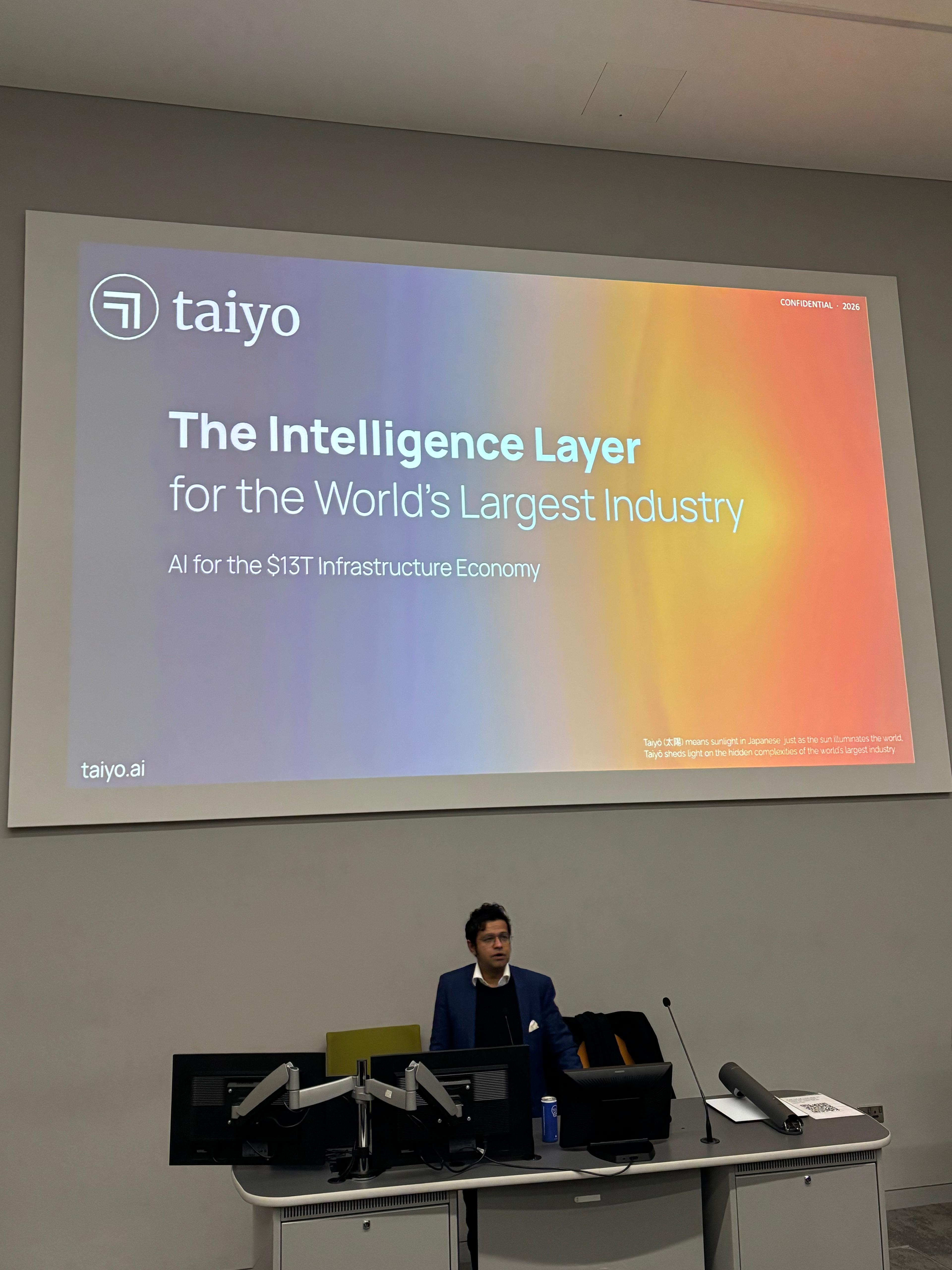
On March 30, 2026, the McNabb Theatre at the Trinity Business School became a focal point for a critical discussion on the intersection of artificial intelligence, infrastructure, and institutional learning. Hosted by the Trinity Entrepreneurial Society (TES), the event brought together students, faculty, and industry leaders for a keynote and strategic dialogue titled: "Cognitive Infrastructure: AI, Critical Thinking, and Learning Systems for a Complex World."
Read next Publication: Cognitive Infrastructure for an Uncertain WorldThe Cognitive Deficit in the Global Economy
Infrastructure — spanning energy, transport, water, and digital connectivity — is the largest industry in the global economy. Yet, as Dr. Saurabh Mishra, CEO and Co-founder of Taiyo.AI, highlighted in his keynote, these multi-trillion-dollar systems often operate with fragmented information and slow learning cycles.
Read next Leading in the Age of Cognitive Infrastructure: Taiyo.AI at SDA BocconiThe core argument of the evening was that the sector is suffering from a "cognitive deficit." We have mastered the physical construction of assets. We have not yet built the institutional memory required to learn from past failures, detect systemic risks early, and reason through long-term uncertainty.
A Strategic Dialogue on the Future of Systems
Following the keynote, Prof. Horacio González-Vélez moderated a strategic dialogue that pushed the concept of Cognitive Infrastructure into the realm of real-world application. The panel brought together Michael Flynn of Deloitte Advisory, who provided vital perspectives on the complexities of project finance and how large-scale investment can be de-risked through public-private partnerships. Prof. Martina Kirchberger of Trinity College Dublin grounded the discussion in economic reality, explaining how "big data" and spatial analysis are reshaping our understanding of urbanisation and labour markets. And Michael Meagher of Open Ireland Network highlighted the importance of open ecosystems in democratising AI collaboration and digital infrastructure.
What Needs to Change
The dialogue moved through three acts of genuine debate. The panelists opened by identifying what is breaking: institutional knowledge remains trapped in static documents rather than evolving digital workflows, and that siloing is the primary barrier to progress. They then explored what the Cognitive Infrastructure framework makes possible — how combining AI, domain-specific data, and human judgment creates a reasoning layer that allows institutions to adapt faster than the environment around them. The session concluded with a focus on education and career pathways, with the experts emphasising that students in business, economics, engineering, and computer science must learn to "think in systems" if they are to lead in this new era.
A New Framework for Future Leaders
For attendees, the event offered more than theoretical insights — it offered a new framework for navigating the future of work. As infrastructure, policy, and AI continue to converge, the people who will lead are those who can harness data to make better, more informed decisions in high-stakes environments.
A special thanks to our Campus Ambassador, Matthew Thornton, and the Trinity Entrepreneurial Society for the seamless organisation. Discussions like these are essential for bridging the gap between academic research and the practical, grounded intelligence required to build a resilient world.
Follow us on LinkedIn for more updates.